We thought this would be one of our easier projects.
Wibrand came to us with a clear concept. We had enough time to prepare the stand, production went well, and the three-day installation in Berlin was surprisingly uneventful. Apart from breaking two glass panels, that is.
The stand was ready for IFA. The client was happy, and everything worked as planned.
Then the exhibition ended.
Our tools were in storage. Our ladders were in storage. And we had a 3.5-metre-high stand to dismantle.
That’s when things got interesting.
But first, the stand itself. Here’s how we turned Wibrand’s campaign into a 25 m² modular exhibition stand, why a few tiny construction details mattered, and what the project taught us about the part of exhibition logistics nobody photographs.
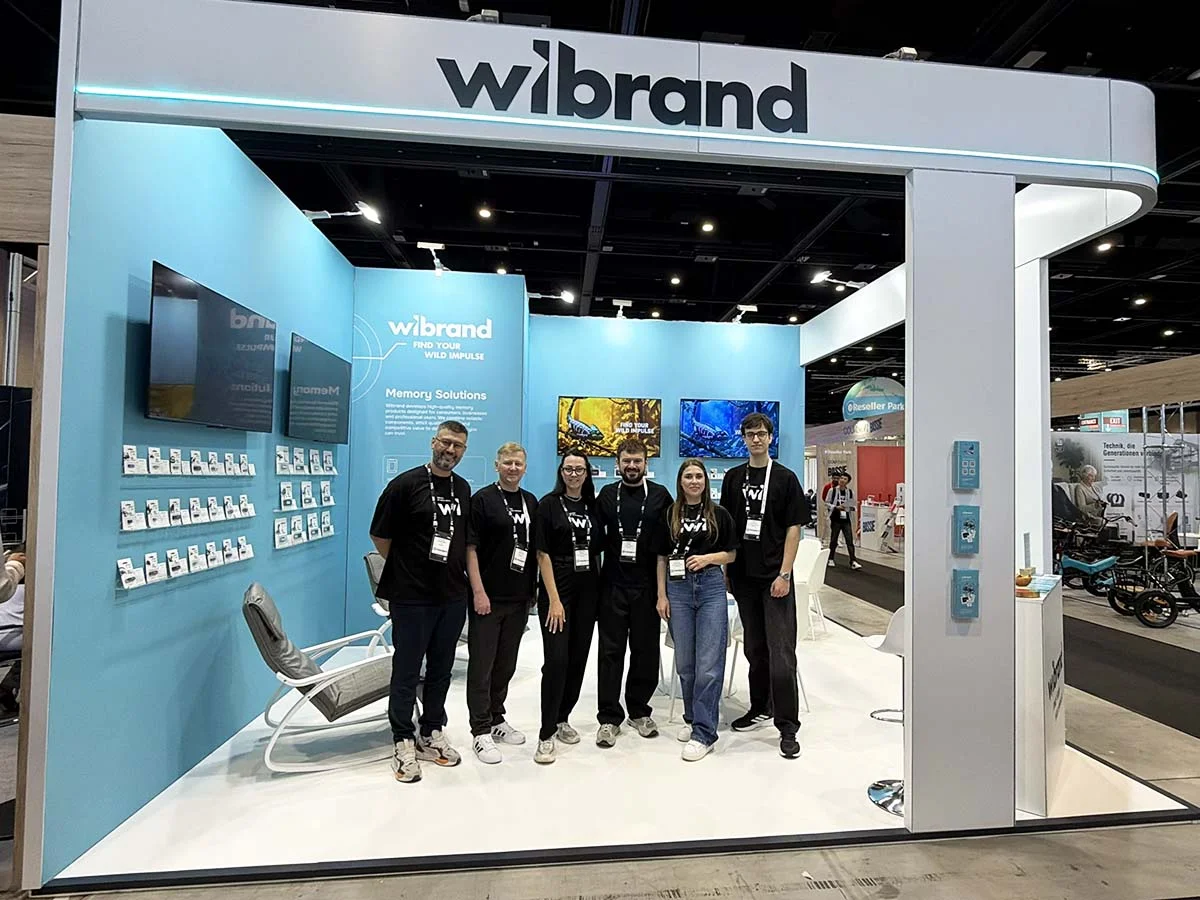
Wibrand’s Wild Impulse, on the IFA Show Floor
Wibrand is a Ukrainian brand of memory and data-storage products: USB flash drives, memory cards, SSDs and DDR memory modules. These are useful products, but not particularly large ones. That matters when you’re trying to make them visible in a hall full of giant screens, bright lighting and competing brands.
Luckily, Wibrand had something more distinctive than another wall of product pictures. Its concept, Find Your Wild Impulse, is about discovering your hidden potential and finding the energy to put it to use. The brand gives that idea a visual form through futuristic cyber-animals. In its campaign video, one animal finds its wild impulse and passes the charge on to the others.
It was a lively piece of storytelling. The challenge for us was to give it a place on the stand without making the actual products disappear behind the spectacle.
We liked that Wibrand arrived with a concept of its own. We weren’t starting from a blank page or asking the client to abandon an idea it believed in. We developed it together, worked out what could be built with our modular system and translated the campaign into a physical space people could actually use.
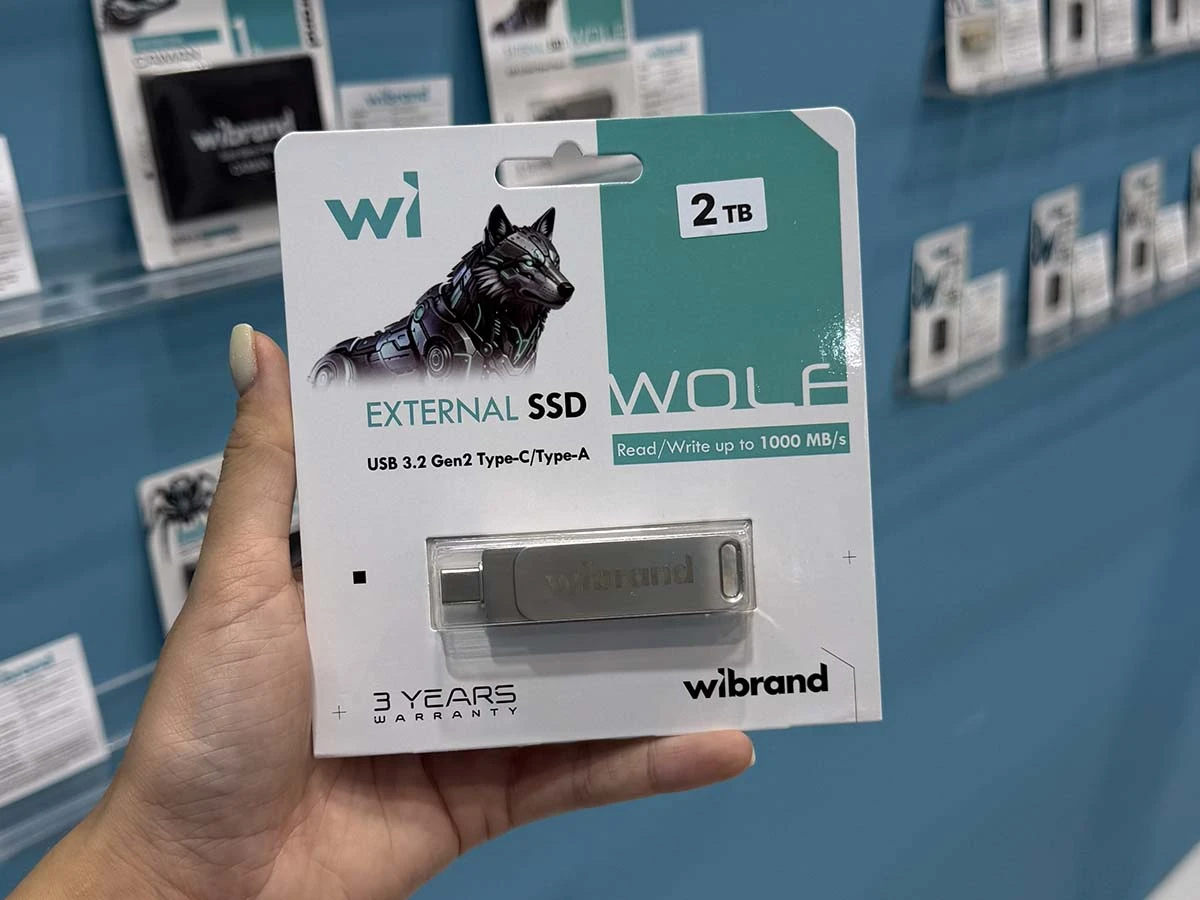
Modular Exhibition Stand Design With a Very Visible Identity
We had a 5 × 5-metre corner plot. Twenty-five square metres doesn’t sound like much once you start adding a reception desk, product displays, a meeting area and a storeroom. We also needed room for four 55-inch screens. And a structure people could recognise from some distance away.
The main job was to balance Wibrand’s bold campaign with a very practical product display. USB drives and memory cards are small. So are many SSDs and memory modules. If a visitor can admire the stand but can’t find the products, the design hasn’t done its job.
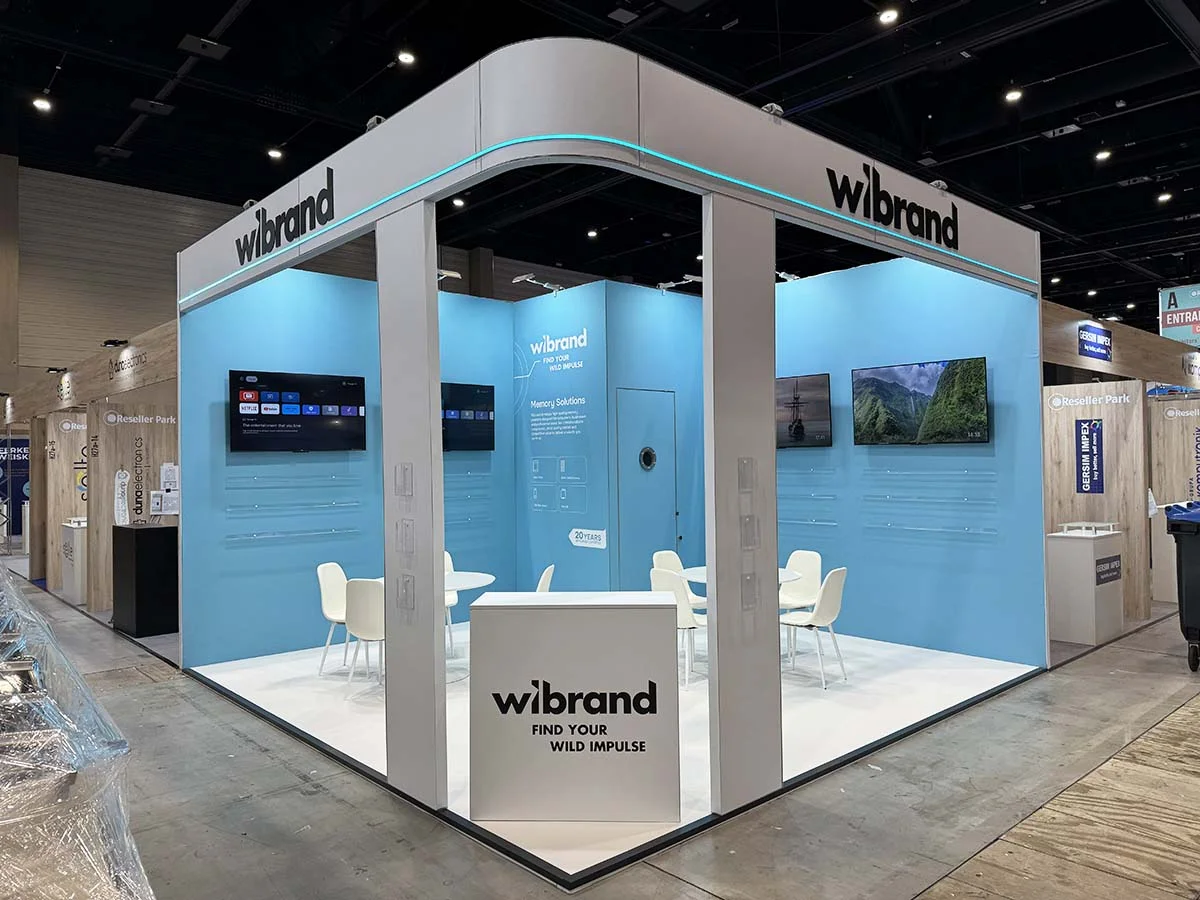
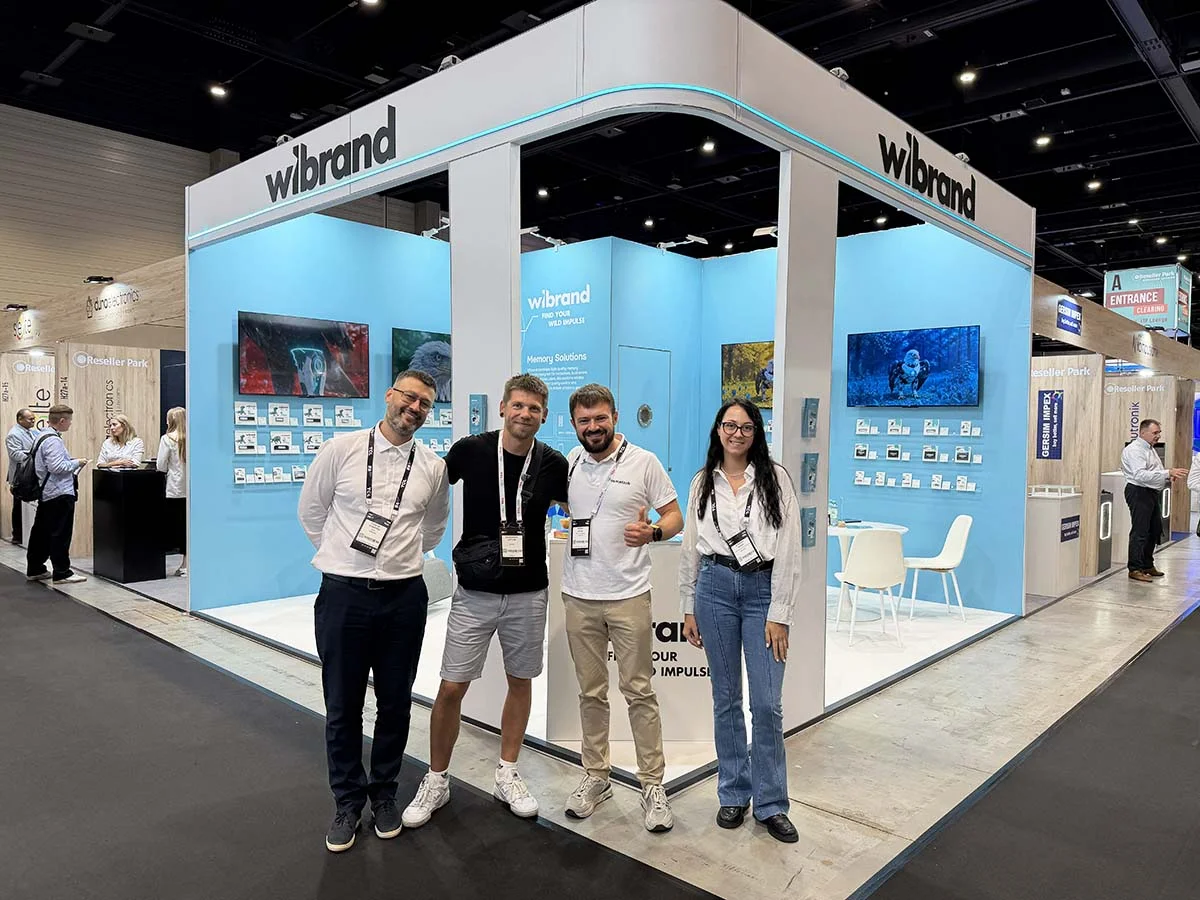
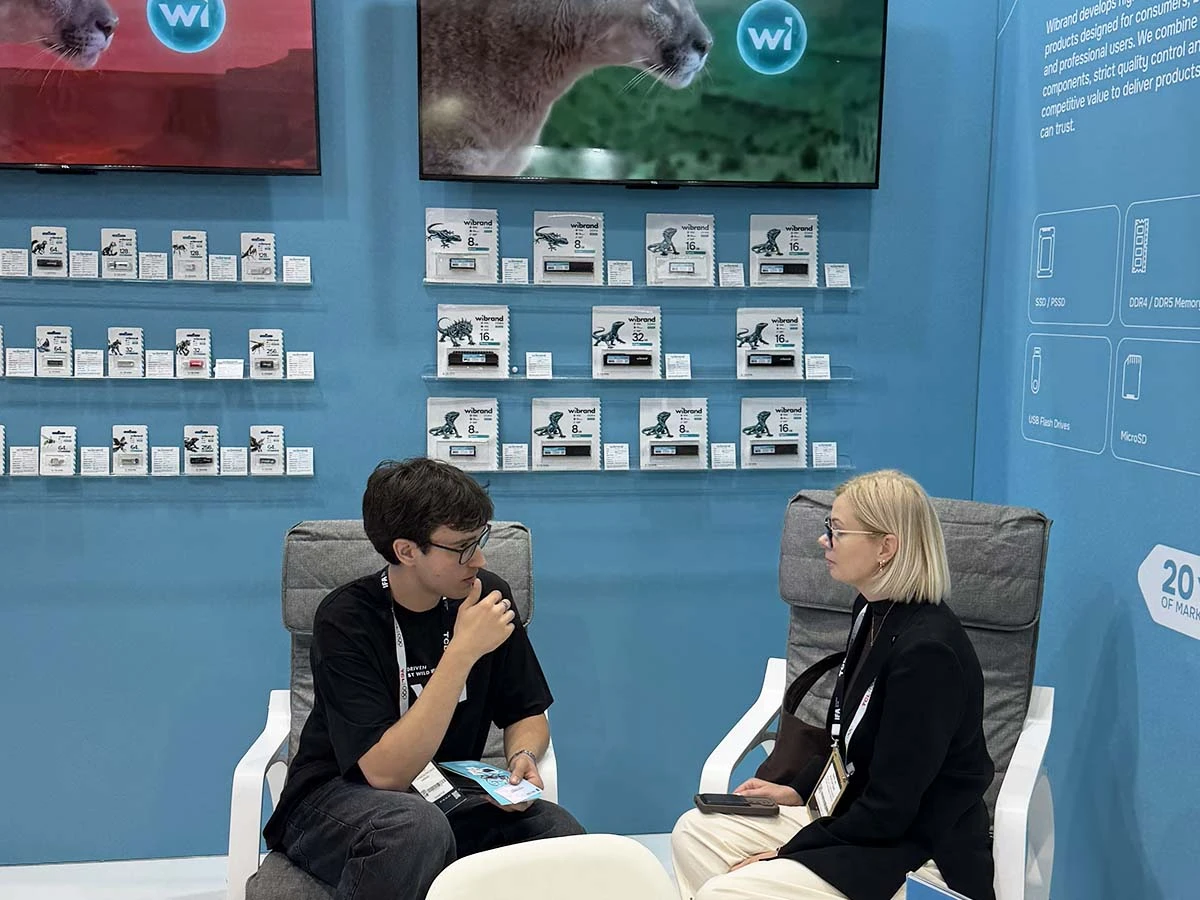
We used a symmetrical layout and kept both aisle-facing sides open. Visitors could walk up to the product displays from either aisle; there was no entrance to hunt for or wall to walk around. The displays sat on transparent acrylic shelves, which did their job without becoming the main attraction.
The four screens carried the Wild Impulse video. The cyber-animal discovered its energy and passed it to the others, while decorative blue-turquoise lighting picked up Wibrand’s brand colour around the stand. The video supplied the character. The layout made sure visitors could still get close to the products.
Above it all sat a large rounded fascia at a height of 3.5 metres. White surfaces, a dark logo and illuminated branding made the stand visible without filling every spare surface with graphics. We kept most of the architecture simple on purpose. The products already had to compete with the rest of IFA; they didn’t need to compete with their own stand as well.
The main structure was modular. That gave us a workable construction method and enough freedom to build the rounded fascia, integrate the screens and match the client’s visual identity. No need to make a modular stand look like every other modular stand.
The Decisions Visitors Never Notice
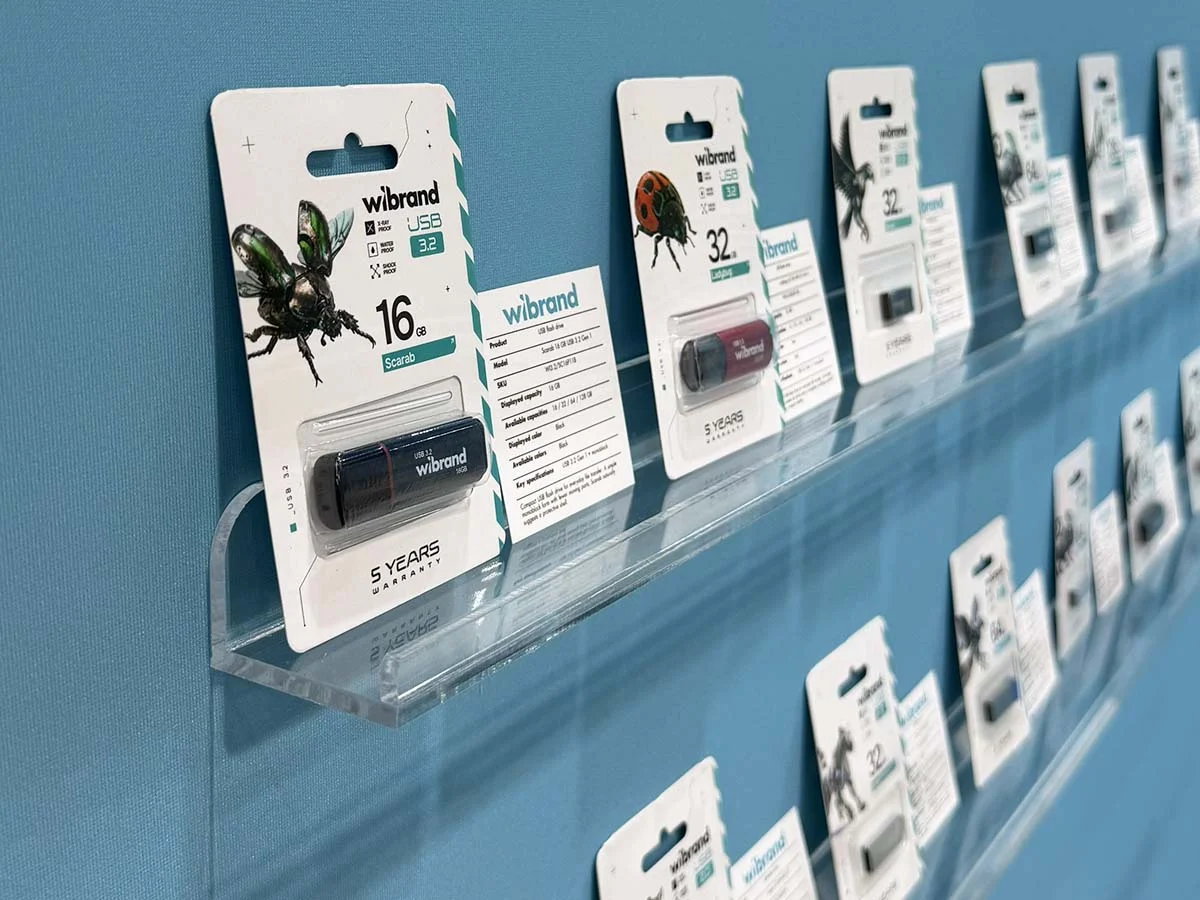
One of the production decisions we spent time on would probably never catch a visitor’s eye. It was about the clear acrylic shelves.
We could have made them by heating and bending a single piece of acrylic. It’s a neat way to get a continuous shape, but it takes more production time. Instead, we cut separate pieces and bonded them together. That made the shelves a little more delicate, so we checked the choice against what they would actually hold. Wibrand’s products were light, and the solution suited this particular display. It wouldn’t automatically be the right choice for heavy equipment.
Once everything was installed, no visitor needed to know any of this. Which is rather the point. The shelf is there to hold the product, not to invite a discussion about acrylic fabrication.
The floor gave us another small surprise. We raised the platform to hide the wiring and covered it with white linoleum. White. At a five-day trade show. We didn’t expect it to look particularly white by the end.
Yet it stayed remarkably clean. The black-painted platform edges connected the floor to the darker accents in the design, and the cables stayed out of sight. Not every material decision produces a dramatic lesson; sometimes you’re simply pleased that something survives real use better than expected.
That’s what a lot of exhibition stand design and construction looks like behind the scenes: checking the weight of a product, saving time on a detail that won’t be noticed, and figuring out where the cables go. None of it makes a spectacular rendering. All of it matters when the stand is built.
Exhibition Stand Installation: Three Days and One Glass Problem
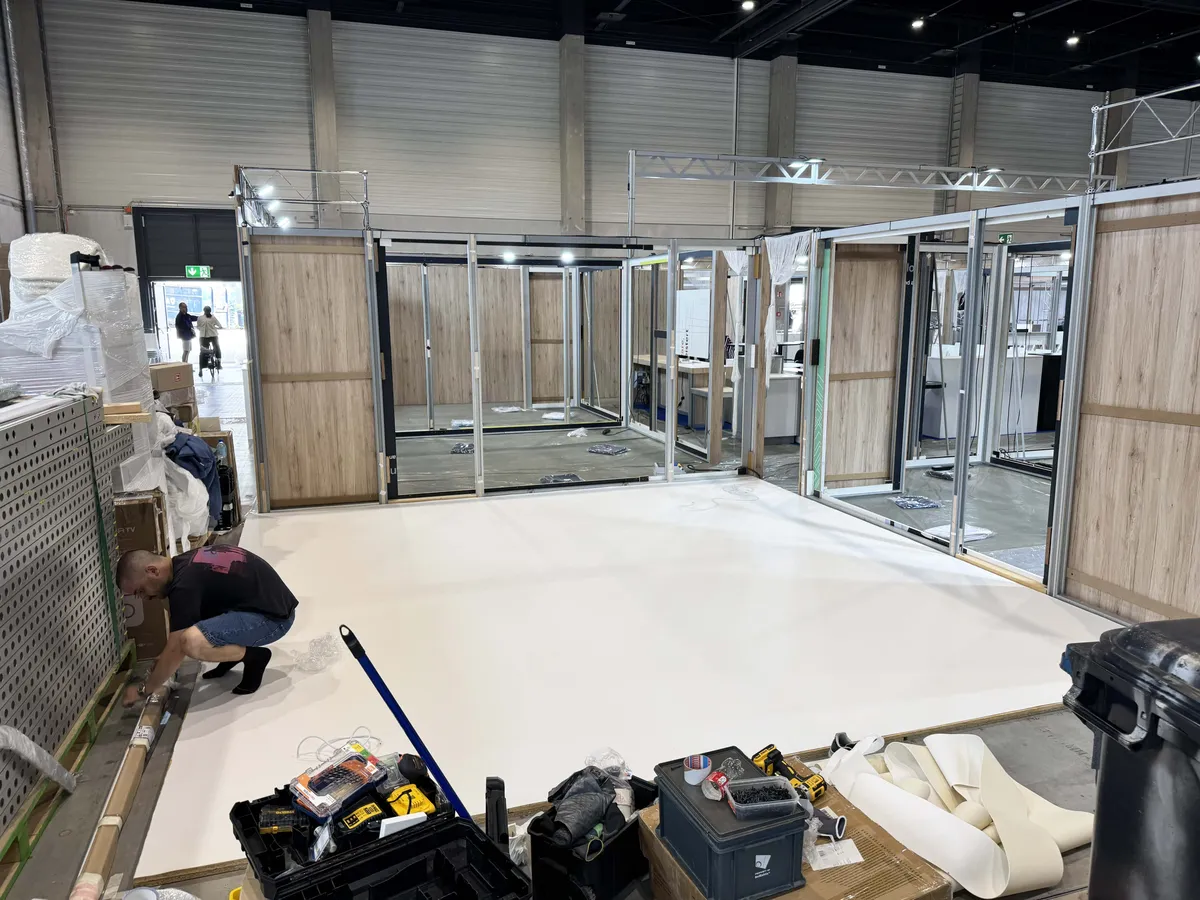
We prepared the stand in Poznań and transported everything to Berlin. Wibrand had approached us a little over a month before IFA, which gave us a reasonable amount of preparation time. On site, we had three full days to build. For this project, the schedule worked.
Of course, building for a trade show also means building to the venue’s rules. Door details, wall finishes, access and other apparently small requirements can have consequences for production. On this stand, the storeroom door needed a vision panel so the enclosed space could be checked from outside.
We knew about it. We brought the glass. We installed the first piece — and broke it.
We tried a second piece. That broke too.
Luckily, we’d brought spares. The third piece survived.
The useful lesson isn’t that glass breaks. Everyone knows that. It’s that knowing the rules and preparing the correct component doesn’t guarantee every part will go in perfectly on the first attempt. Those spare pieces kept a minor installation problem from turning into a trip to find replacement glass.
Otherwise, the installation went smoothly. The screens, lighting, shelves and product areas were ready before IFA opened. Wibrand could concentrate on presenting its products rather than chasing unfinished construction work.
Want to see how it all came together? We filmed the build in Berlin, from the modular frame to the high illuminated fascia and the final details. Watch the behind-the-scenes video below. It also tells the story of what happened after the show closed — the part we really didn’t see coming.
Exhibition Stand Dismantling: The Difficult Part Began After IFA Closed
You might think that once the five-day show is finished, dismantling is simply installation in reverse. We wish it were always that straightforward.
After installation, we had sent one pallet to the event storage service. It held our tools, equipment and, most importantly, our ladders. Before dismantling, our project manager ordered priority return. That service cost more, but our schedule was tight, and we needed the equipment back at the right time.
Dismantling began at 6 p.m. on Friday. Our truck was due at 2 p.m. on Saturday. We needed the stand down, packed and ready to load by then.
But the pallet didn’t arrive.
We later learned that the priority request had been switched to normal delivery without anyone telling us. Somewhere in storage sat the pallet with all our ladders, while the hours kept passing.
Our team rearranged the work around the equipment that was actually available. The lack of ladders was not just annoying: it affected which parts of a 3.5-metre structure could be tackled and when. Access equipment for work at height is a safety requirement, not something you simply replace with determination. This incident exposed a weak point in our storage plan, and it’s one we would handle differently next time.
The pallet finally arrived at around noon on Saturday. Our truck was coming at two. After all that waiting, the ladders were back with just two hours left before loading.
The team still managed to have the stand dismantled, packed and ready on time.
We can laugh about the timing now. But next time, we will think twice before putting every ladder on the same pallet. Having a confirmed priority service isn’t the same as having guaranteed access to critical equipment.
What This Project Taught Us About Exhibition Stand Logistics
Some exhibition stand construction challenges don’t appear until the show is over. Our client didn’t need a detailed account of the storage service’s internal process. The job was to present Wibrand’s products during IFA and complete the agreed dismantling afterwards. Still, the experience is worth sharing because exhibition stand project management relies on a surprisingly long chain of handovers: approvals, deliveries, venue services, installation teams, storage and collection slots. One late handover can put pressure on everything after it.
If you’re preparing for your own exhibition, here are the points we’d take from this project:
- Check the entire lifecycle, not just the opening date. The dismantling window and truck collection can be just as unforgiving as the build-up deadline.
- Identify equipment that cannot be delayed. Access equipment and specialist tools need a verified return arrangement or an appropriate backup.
- Allow for small production failures. Extra components can resolve an installation problem that would otherwise consume precious time.
- Treat venue rules as design inputs. A storeroom door, access ramp, wall finish or power connection can affect construction details long before the team reaches the hall.
- Keep decision-making close to the site. Someone needs a clear view of the timetable, service providers and the options available when a plan changes.
You don’t need to expect disaster at every exhibition. You do need to know which part of the plan depends entirely on someone else — and what happens if that part fails. That’s one of the less visible challenges of exhibition stand construction.
Two Teams, One Finished Exhibition Stand
For five days at IFA, Wibrand had an open, bright place to show its products and talk to visitors. The cyber-animals moved across the four screens. The high illuminated fascia carried the brand above the busy aisles. Below it, USB drives, memory cards and other products were where visitors could actually see them.
We particularly enjoyed working with a client that had a strong idea of its own and wanted to develop it with us. We didn’t have to invent a personality for Wibrand. We had to make space for the personality it already had.
We’ll certainly remember the missing ladders. But we’ll remember the finished stand, the collaboration and the Wibrand team too. Thank you for trusting ESBAU with the project. We hope to see that Wild Impulse at many more exhibitions.
Planning an exhibition stand in Europe? ESBAU designs and builds modular and custom stands, coordinating the construction details that visitors rarely see. Explore our exhibition stand project management service or tell us about your next event.