


When clients ask me what makes a booth “good,” I usually answer with another question: good for what exactly? Over the last ten years working at trade shows, I’ve seen beautifully designed booths fail — and
very modest ones outperform expectations. The difference was never about trends or fancy materials. The question was whether the booth was created around genuine goals, real people, and real limits.
So when we talk about what makes a good trade show booth, we’re really talking about how well it works under pressure: tight schedules, limited space, tired staff, and visitors who make decisions in seconds.
In real projects, the first warning sign usually appears very early — when different people inside the company give different answers to the same question about the booth’s goal.
What “Good” Means: Goals, Audience, and Booth Success Metrics
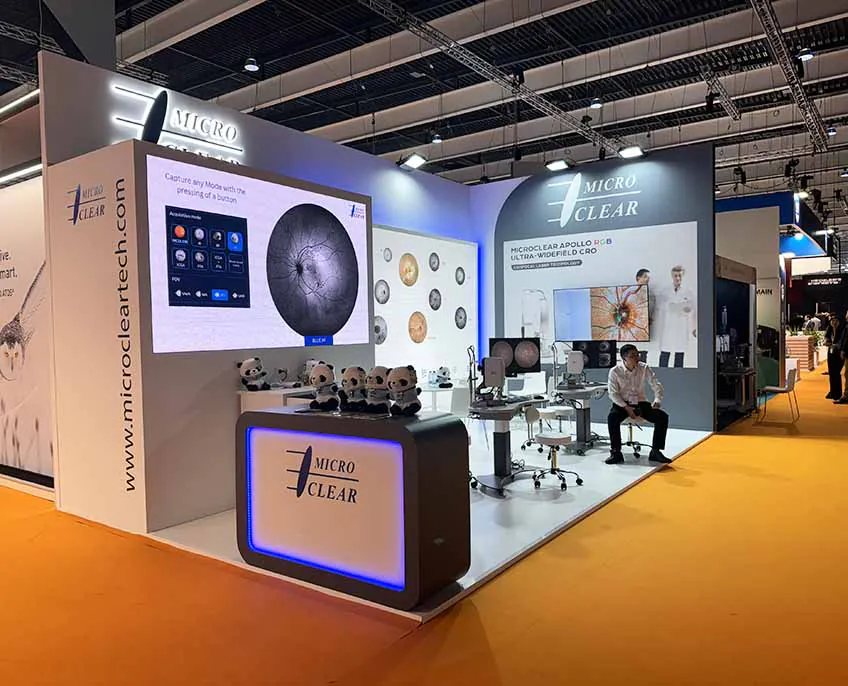
A good booth starts before exhibition booth design, not after. One of the most common mistakes I see happens long before design begins. Companies jump straight to visuals without agreeing internally on what the booth should actually do.
From a project perspective, that almost always leads to rework, budget overruns, or disappointment on-site.
Define the booth goal (leads, meetings, demos, brand awareness)
Define one primary exhibition stand goal (and accept the trade-offs).
A booth cannot do everything at once. In practice, every trade show booth design performs best when it is built around one main goal:
- generating qualified leads
- holding pre-booked meetings
- running product demos
- supporting brand entry into a new market.
I’ve worked on booths where the client tried to combine all four — and ended up with none working properly. Clear priorities are a big part of what makes a good exhibition stand effective.
According to CEIR, 81% of trade show attendees have buying authority or influence. That’s a strong argument for clarity, not complexity.
Match the booth to your audience and offer
Know who should stop — and who shouldn’t.
Another uncomfortable truth: a good booth does not try to attract everyone.
When the target audience is unclear, booth traffic increases, but conversation quality drops. Sales teams get exhausted, and follow-up becomes meaningless.
From experience, booths that intentionally filter visitors — through messaging, layout, or demo focus — deliver far better results. That filtering is often invisible, but it’s essential to booth design that actually works.
Trade Show Booth Design Fundamentals
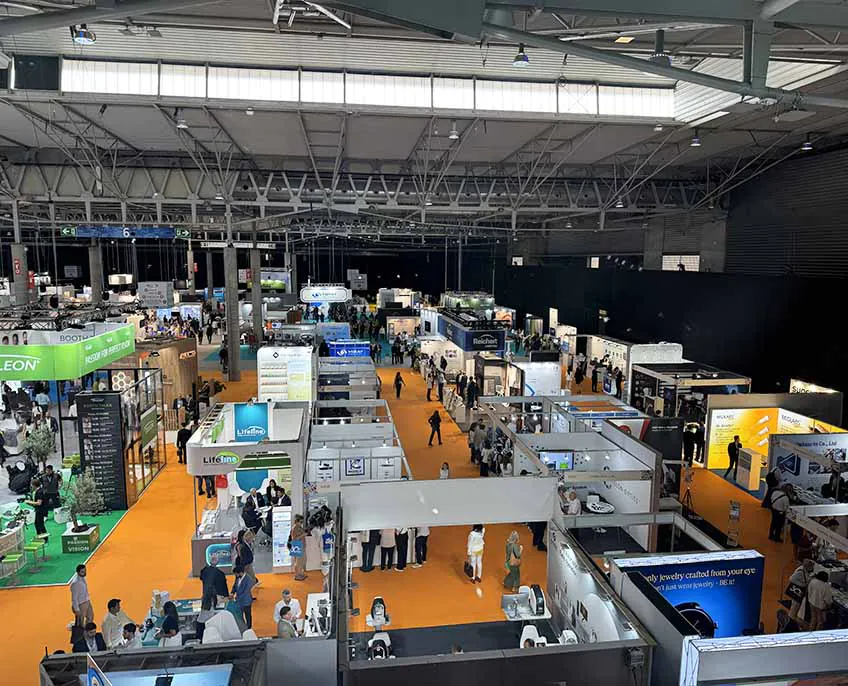
Layout problems I see at almost every show.
Most layout issues don’t come from bad exhibition booth design. They come from underestimating how people behave in a crowded hall. I’ve seen booths lose half their potential simply because one counter was moved 30 centimeters too close to the aisle.
Layout and flow: entrances, demo zones, meeting space
Blocked entrances and “accidental walls”.
Clients are often surprised when their stand feels empty despite good traffic. In many cases, the problem is simple: furniture, counters, or demo screens placed too close to the aisle create a psychological barrier.
Good exhibition booth design keeps the entrance open and obvious. Visitors should understand where to stand and what to do within a few steps — not after a conversation.
No separation between demos and meetings.
Another common problem is that demos and meetings happen in the same room. This makes noise, breaks, and makes everyone angry.
Even small booths benefit from obvious zoning: demos or presentations should be closer to the aisle, while talks should be a little deeper inside.
This basic flow improves both engagement and lead quality and is a core part of practical trade show booth tips.
Messaging hierarchy: one clear promise in 3–5 seconds
Why less almost always works better.
From a project manager’s point of view, messaging problems cause more last-minute panic than any other factor. Most last-minute panic happens not because the message is wrong, but because no one decided which message matters before files go to print.
Too many messages, too little clarity.
Clients typically try to put everything on the walls: products, services, slogans, and sub-brands. The end consequence is visual cacophony.
A good trade show booth design answers three questions quickly:
- Who are you?
- What do you help with?
- Why should I stop here?
Anything else belongs in conversation, not on the wall.
Exhibition lighting, Graphics and visibility from the aisle
Graphics that look good — but don’t communicate.
Designers sometimes optimize for beauty, not legibility. Thin fonts, low contrast, or clever metaphors may look great in a mockup but fail on the show floor.
Exhibitor Magazine repeatedly points out that visibility and contrast directly affect engagement time. From experience, readable and direct graphics outperform “creative” ones in almost every B2B case study we’ve worked on.
Trade Show Booth Ideas That Actually Work
Trade show booth ideas that survive real-world conditions.
Exhibition stand ideasonly matter if they survive long show days — when staff are tired and visitors don’t want explanations.
Simple booth design ideas (low budget, high impact)
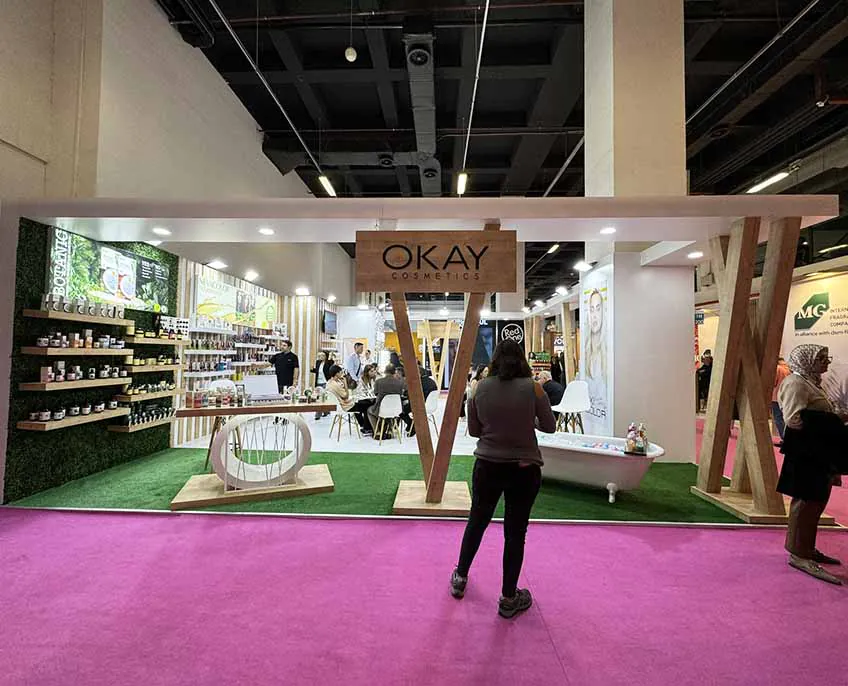
Some of the most reliable simple booth design ideas I’ve seen include:
- one strong visual focus instead of multiple screens
- modular elements reused across different events
- materials that are durable and eco friendly, not fragile
- using maximum tree main colors.
These solutions are usually more cost effective and easier to manage during installation.
Interactive elements that don’t create chaos
Interactive elements: helpful or distracting?
Interactive technologies are useful when they cut down on the time it takes to explain things. They don’t work when they need help.
Freeman’s research suggests that engagement goes up when interactions are easy to understand and led.
From practice, a short demo beats a complex interactive system every time.
How to Drive Booth Traffic Before and During the Show
Traffic doesn’t happen by accident.
A well-built booth can still underperform if no one knows why they should visit it.
Pre-show outreach: email, LinkedIn, appointment setting
Pre-show preparation most teams underestimate. Many clients expect traffic to “just happen.” In reality, strong booth traffic usually comes from:
- pre-booked meetings
- targeted email or LinkedIn outreach
- clear reasons to visit the stand.
Exhibitor data suggests pre-show promotion can increase visits by up to 40%, which matches what we see when meetings are booked before the show.
On-floor tactics: signage, demos, micro-events, staff positioning
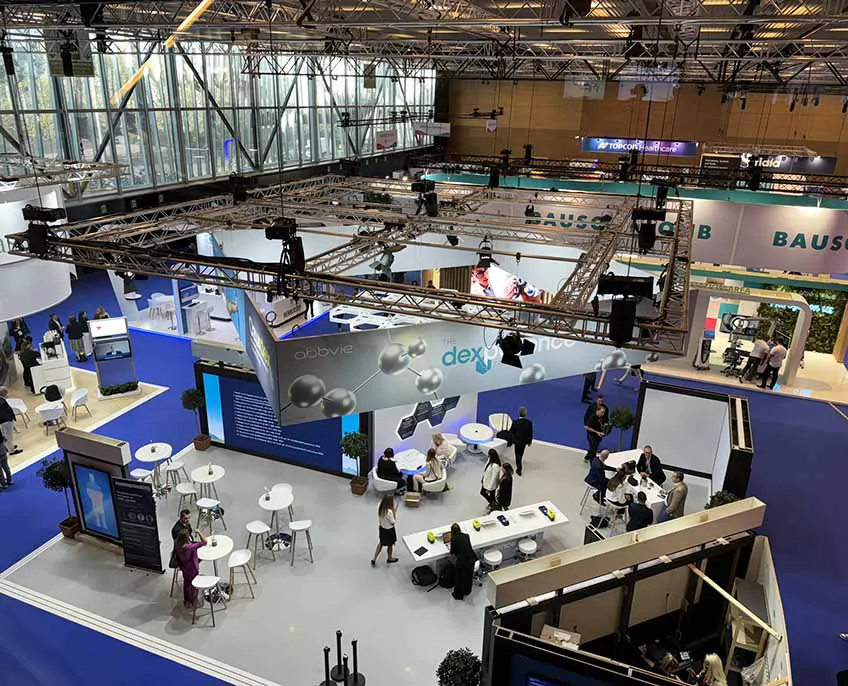
Even a well-designed booth can underperform if on-floor tactics are weak. From practical experience, most problems during the show are not design-related — they’re operational. If a demo cannot survive interruptions, noise, and people walking away mid-sentence, it usually won’t survive a real exhibition day.
Signage must work at eye level and from a distance. I regularly encounter graphics that are too low, too high, or too full with text. On a busy floor, signs have one job: to let the proper visitor figure out what’s important in a few seconds. The signs failed if personnel have to explain what the business does before a guest even walks in.
Demos should be short and repeatable. Long presentations fall apart in real life because of interruptions, noise, and traffic that isn’t always even. The best demos I’ve done were 3 to 5 minutes long and could be started over at any time without losing their meaning.
Micro-events — short, informal moments like scheduled mini-demos, live tests, or Q&A slots — work well when clearly announced and time-boxed. They make the stand sound good without turning it into a theatrical spectacle that gets in the way of traffic.
Staff positioning is often underestimated. Putting the most talkative folks in the aisle and the most knowledgeable people deep inside is a common mistake. In real life, the first contact should be someone who can sort and qualify, not overwhelm. Just changing the position of the booth can quadruple the number of relevant talks without changing the design.
Turning “traffic” into conversations (openers and qualification)
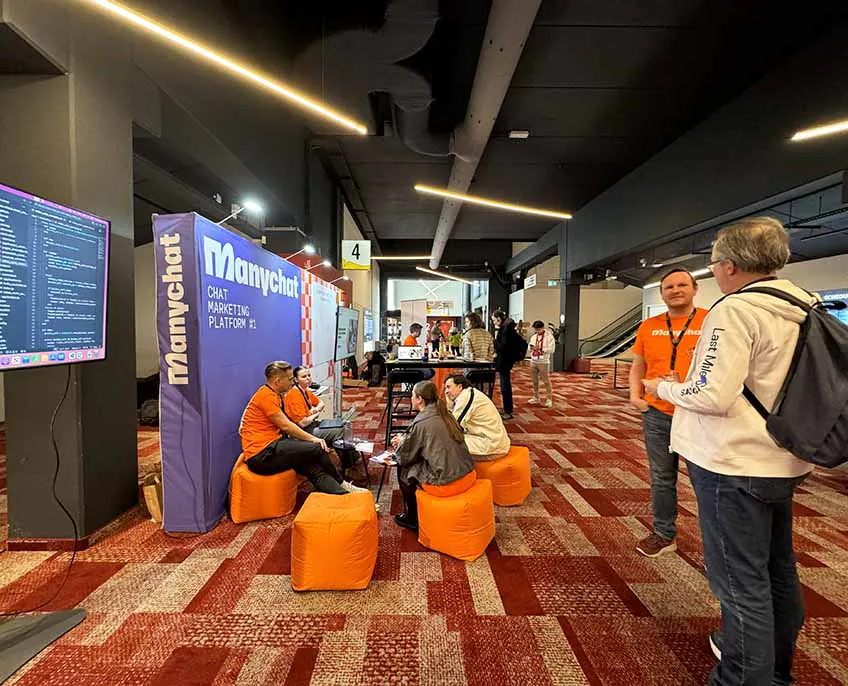
Staff behavior matters more than design. I’ve seen average booths outperform great ones simply because staff knew how to engage without blocking entrances or overwhelming visitors.
At almost every show, I hear the same phrase from clients on day two: “We didn’t expect it to be this exhausting.” That’s usually when structure starts to matter.
Training and positioning are often overlooked but remain essential trade show booth tips.
Trade Show Booth Tips for Lead Capture and Follow-Up
Lead capture and follow-up: where value is often lost.
Many exhibitors invest heavily in the booth — and then lose leads in the follow-up phase.
Lead capture setup: scanners, QR, forms, data rules
Capture context, not just contact details.
The most common post-show complaint I hear is: “We collected leads, but sales didn’t convert them.”
In most cases, the issue isn’t lead quality — it’s missing context. Effective exhibition stand tips include:
- tagging leads by interest or discussion topic
- noting urgency on-site
- agreeing on next steps before the visitor leaves.
Salesforce research shows faster follow-up dramatically improves conversion.
Quick lead qualification: hot/warm/cold + next step
Collecting leads without qualification is one of the fastest ways to waste exhibition budgets. From a project manager’s point of view, lead qualification must be simple enough to work under pressure. One simple question — “What happens next?” — filters better than any lead scoring system when the hall is busy. Lead generation shoud have a proper strategy.
A practical hot / warm / cold model works well on-site:
- Hot: clear need, authority, and near-term decision
- Warm: interest confirmed, timing unclear
- Cold: general interest or future relevance.
What matters most is not the label, but the next step attached to it. Every qualified conversation with decision making person should end with an agreed action:
- follow-up call
- demo invitation
- proposal request
- content or case study send-out.
When teams skip this step, sales later receive “leads” without context. In real projects, adding one simple question — “What should happen next?” — dramatically improves post-show conversion. Use this in your marketing strategy.
Post-show follow-up within 48 hours (what to send and to whom)
Post-show follow-up is where the real value of the booth is either captured or lost. In practice, the first 48 hours are critical.
For hot leads, follow-up should be personal and specific:
- reference the actual conversation
- confirm the agreed next step
- avoid generic marketing language.
For warm leads, the goal is continuity:
- short recap
- relevant content (not everything) & clear option to move forward.
For cold leads, automation is acceptable, but relevance still matters. A short message explaining why they are receiving the email performs far better than a mass “thank you for visiting our booth” note.
Salesforce data shows that faster follow-up significantly improves conversion, but speed without context rarely works. The message must remind the recipient who you are and why the conversation mattered.
Exhibition Stand Checklist: Avoid Common Mistakes
After managing dozens of exhibition projects, I can say this clearly: most failures are predictable. A simple exhibition stand checklist prevents expensive surprises.
Checklist: design & content (print files, messaging, visuals)
Before shipping anything to the venue, always double-check:
- final print files approved and version-controlled
- messaging hierarchy clear (one main message, not five)
- visuals readable from real viewing distances
- no last-minute text changes without rechecking layout.
Many on-site issues come from rushed approvals, not bad trade show booth ideas or build.
Checklist: operations (logistics, installation, power, Wi-Fi, compliance)
Operational problems are invisible in renderings but very visible on-site:
- installation schedule confirmed with the venue
- power and internet ordered and tested
- local regulations and height limits checked
- backup plan for delays or missing elements.
As a manager, I always assume something will go wrong at event — and plan accordingly.
Checklist: people (staffing plan, training, shift schedule)
Even the best booth fails with an unprepared team:
- clear roles (greeter, demo, closer)
- basic product and qualification training
- shift schedule to avoid burnout
- alignment on lead capture rules.
From experience, tired or confused staff hurt performance more than any design flaw.
So, what makes a good trade show booth from a project manager’s perspective?
It’s not the most expensive exhibition stand or the boldest concept. It’s a booth that respects how people move, decide, and communicate under real exhibition conditions. When goals are clear, layout is practical, messaging is focused, and the team is prepared, the booth starts working as a business tool — not just a visual presence.
After managing exhibitions for more than a decade, I’ve learned that most successful booths are not the most creative ones, but the ones that were thought through early and adjusted calmly on-site.