



Congratulations! Are you planning to hire more people?
That is probably not the first question you expected after deciding to buy a trade show booth. Yet it may be the most important one. Most companies compare quotations before making their decision, but very few ask who will actually take responsibility for the booth after the exhibition closes.
Who will organise storage? Who will arrange transport? Who will inspect damaged components, prepare the booth for the next event and make sure it still fits the new floor plan? Buying a booth is the easy part. Keeping it exhibition-ready requires people who know exactly what they are doing.
If nobody in your company owns that process, you are not simply comparing buying with renting. You are comparing two completely different operating models. This article will help you compare the full responsibility, cost and flexibility behind each option before the decision becomes expensive to reverse.
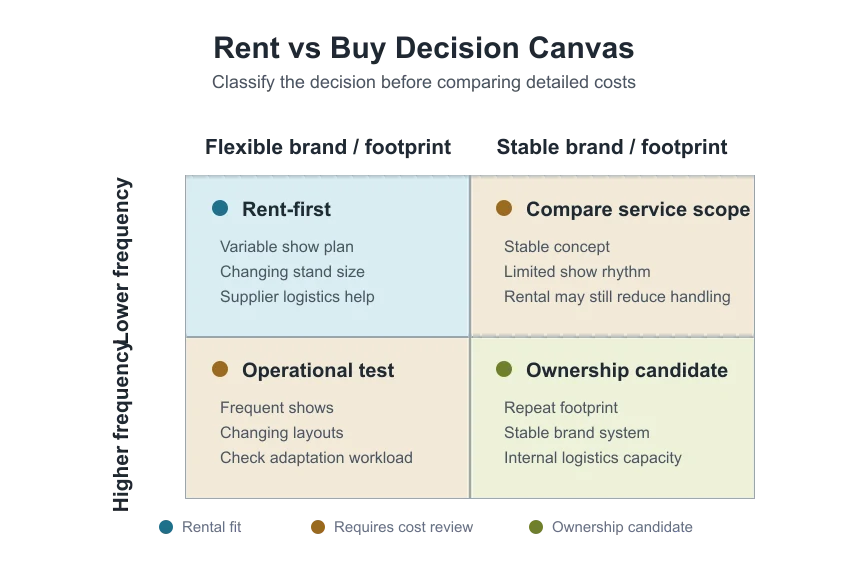
Decision Canvas
Use this canvas before reading the cost sections. It is meant to expose the operating reality behind the invoice.
- How many exhibitions will use the same booth configuration in the next three years?
- Will the footprint, open sides and venue rules stay similar enough for reuse?
- How often will your product range, message or brand visuals change?
- Will the shows happen in one region or across several countries?
- Who will inspect, pack, transport, store, repair and prepare the booth after each event?
- Which services are included in each supplier proposal, and which remain your responsibility?
If your answers point to stable dimensions, repeated use and a team that can manage the booth between shows, ownership deserves analysis. If they point to changing markets, uncertain stand sizes or limited internal operations capacity, a trade show booth rental model may reduce deadline risk.
Think of it like a business vehicle: ownership works when the route is predictable and maintenance is managed.
What Does Trade Show Booth Rental Actually Cost?
A trade show rental booth is usually priced as a per-show solution. The fee may include design adaptation, use of a structural system, graphics, furniture, lighting, project management, transport, installation and dismantling. Venue services, rigging, utilities, internet, cleaning and organizer charges may still sit outside the proposal, so the useful document is the scope behind the trade show booth rental cost.
The practical advantage of trade show exhibit rental is that the exhibitor normally does not need to own, store or maintain the underlying system. A trade show booth for rent does not have to look generic; it can still support brand presentation, product flow and meeting areas.
What’s included in a trade show booth rental service
Trade show booth rental services should define more than the visible stand. A serious offer states the design scope, construction system, printed graphics, furniture, AV items, transportation, installation team, dismantling, project management, post-show handling and exclusions.
Turnkey trade show booth rental is the broadest model. In this arrangement, the vendor manages the booth from concept to dismantling. This is useful for first-time exhibitors, international exhibitors and companies without staff who can manage exhibit inventory, freight and I&D labor trade show requirements.
Trade show display rental pricing by booth size
Trade show display rental pricing changes with size, height, complexity, materials, location, schedule and service scope. A small inline booth is a different commercial product from an island trade show booth rental with open sides, overhead elements and meeting areas.
Universal prices can therefore mislead. Compare rental proposals by asking what is included, what is excluded, what changes trigger additional cost and who carries responsibility after the event.
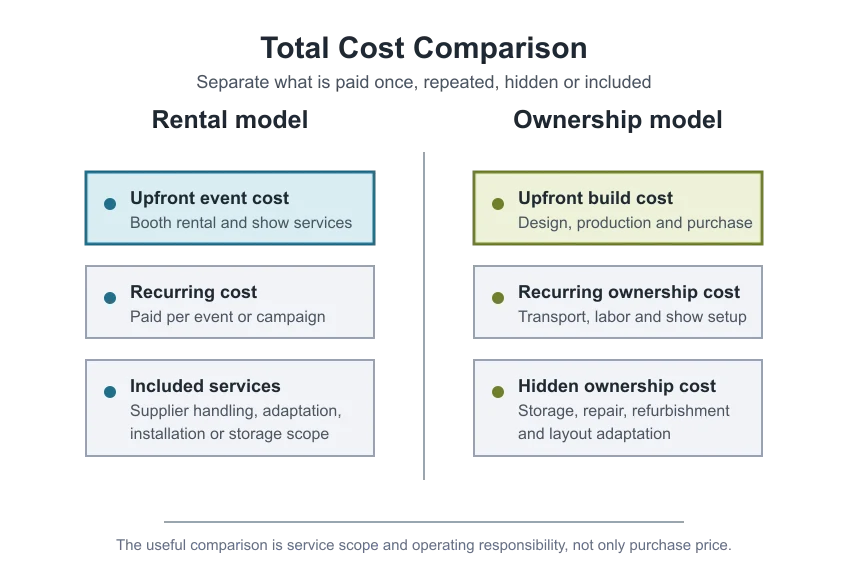
What Does Buying a Custom Trade Show Booth Actually Cost?
Buying can mean several things: a modular display system for repeated assembly, or a custom trade show booth fabricated for a specific footprint, product display and brand concept. Those are different business decisions.
Upfront fabrication cost
The upfront purchase price usually covers trade show booth fabrication, engineering, materials, graphics, finishing, packing and initial installation support. Once ownership transfers, the exhibitor gains control over the asset and inherits the job of keeping it usable.
This is where purchase comparisons often become distorted. Fabrication cost is only one part of trade show exhibit cost of ownership. The booth must be protected, transported, inspected, repaired and sometimes redesigned before it can create value at the next event.
Hidden ownership costs: storage, freight, I&D, refurbishment
Owned booths create work after every show: trade show booth storage, trade show booth shipping, insurance, packing materials, inspection, cleaning, refurbishment, replacement graphics, floor-plan adaptation, and booth installation and dismantling labor.
There is also depreciation. A booth may remain in inventory but become commercially wrong because the product range, brand system, safety rules or footprint changes. If a major brand refresh happens early, the savings from ownership can disappear.
The Break-Even Point: When Does Buying Make Sense?
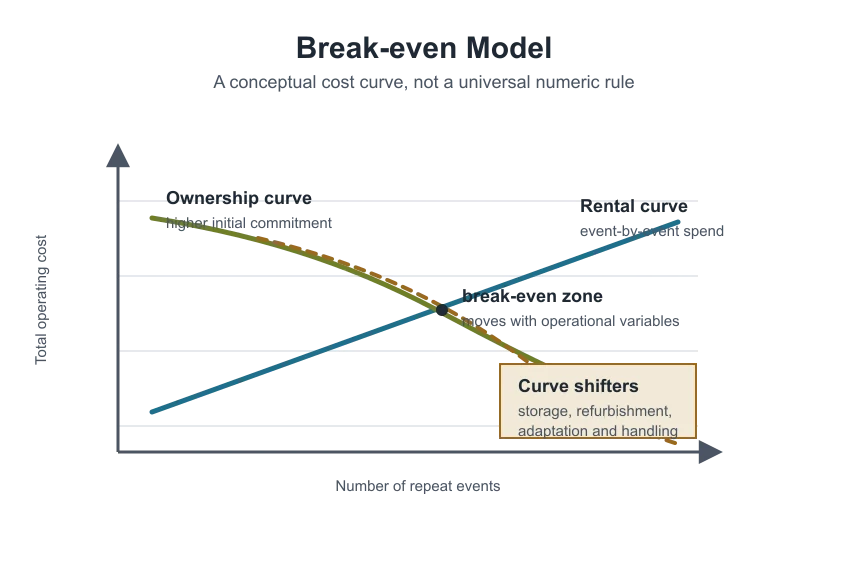
The break-even point is not a universal number of shows. It compares total ownership cost and total rental cost over the same real exhibition period.
Use this model:
- Total ownership cost: purchase price plus storage, shipping, I&D labor, repair, refurbishment, redesign, graphics, management time and unusable components.
- Total rental cost: per-show rental fee plus excluded venue services, late changes, additional graphics and any special equipment.
Buying may make sense when the booth is used often, the footprint is stable and the company can manage exhibit storage and logistics. Renting may make sense when the booth format changes, the program is uncertain or supplier-managed operations reduce internal workload.
How to calculate your break-even by show frequency
Start with a realistic period, such as the next three years. Count only shows that can use the same booth configuration without major reconstruction. Add the continuing costs between shows, then compare the per-event ownership cost with the trade show booth rental cost for those same events.
This calculation often changes the conversation. Six similar uses are different from six planned shows where the booth is redesigned after the second one.
What happens if your brand changes before break-even
Break-even can move or disappear if the booth cannot be reused as planned. A new product launch, different stand size, new market, rebrand or damaged component can require new graphics, altered construction or partial replacement. Then trade show booth depreciation becomes a practical cost, not theory.
Design Flexibility: Rental vs Custom Trade Show Booth
Design flexibility is often misunderstood. Buying gives control over owned components, but it can also lock the exhibitor into dimensions, materials and structural choices. Rental can limit some physical options while supporting new layouts and graphics from show to show.
Renting a custom trade show booth – how flexible is it?
Renting a custom trade show booth can be flexible when the exhibit house has strong modular inventory, fabrication capability and project management. The exhibitor receives a branded environment without taking on full ownership. This helps when campaigns change, product ranges rotate or shows have different spaces.
The important point is whether the supplier can adapt the environment without turning every change into a new construction project.
Owned booth: what you can and can’t change
An owned booth can preserve a consistent identity, especially for companies with a stable annual program. However, structure, height, storage volume, counters, meeting rooms and technical integrations may be tied to the original concept. Hybrid trade show exhibit options can help by combining owned reusable elements with rented or refreshed components.
Ownership works best when the company is honest about what should stay stable.
Logistics: What Happens Between Shows?
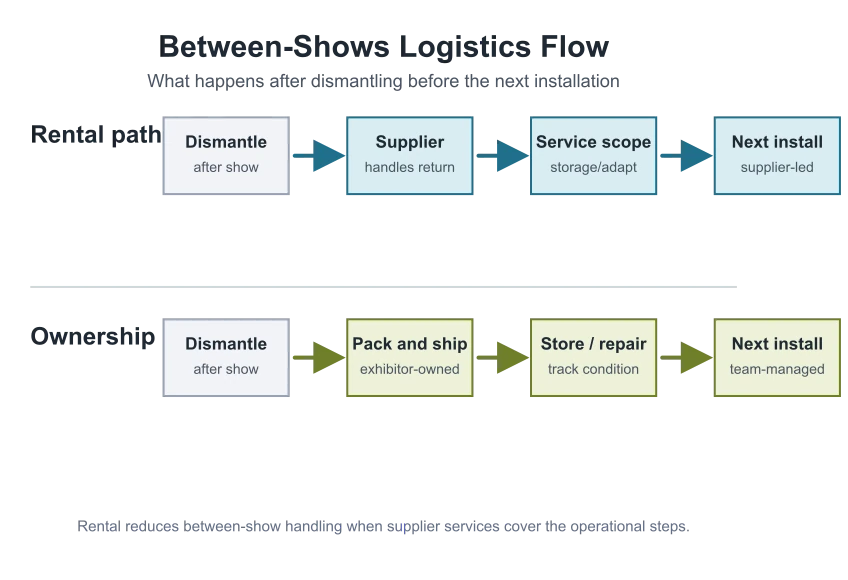
The most important cost difference often appears after the event closes. A booth is not ready for the next show because it was used once. It must be dismantled, checked, packed, moved, stored and prepared again.
Many teams underestimate this because it happens after the visible success of the event. Then the booth becomes a logistics problem with deadlines, missing parts, freight documents and storage decisions.
Turnkey trade show booth rental: vendor manages everything
In a turnkey rental model, the supplier usually manages dismantling, post-show handling and preparation for the next project. This reduces the exhibitor’s need for internal logistics knowledge and can reduce the risk of missing parts, poor packing, storage damage or cross-border shipment problems.
The exhibitor still manages decisions, approvals and deadlines. But the operational responsibility is narrower, which matters for companies exhibiting outside their home market.
Owned booth logistics: storage, shipping, inspection
With ownership, the exhibitor needs a process. Someone must confirm components, identify repairs, arrange freight, maintain inventory records and make sure the booth can meet the next venue’s requirements. International programs add customs, timing and local labor coordination.
If nobody owns this process internally, the booth is simply stored somewhere until the next deadline exposes the missing work.
Which Is Right for You? Recommendations by Exhibitor Profile
The model depends on your operating reality.
- One-time or first-time exhibitor: rental is usually safer because it limits ownership risk and lets the supplier manage the process.
- Company attending several shows with different footprints: rental or hybrid planning is often better because each event may require a different structure.
- Company with a stable annual program and standard booth: buying can make sense when storage, transport and refurbishment are controlled.
- Company buying a simple modular self-build system: ownership may be efficient for smaller, repeatable events, but it may not replace a full custom environment.
- International exhibitor working across several countries: trade show exhibit rental can reduce freight and storage complexity.
- Brand with frequent visual or product changes: rental usually preserves flexibility. Ownership may become expensive if refurbishment repeats.
- Company with internal storage and exhibition operations: buying may create value if the team can manage inventory, I&D and repairs.
- Company requiring a hybrid solution: combine owned reusable assets with rented structures, refreshed graphics or locally produced elements.
Use this list to identify which risk you are accepting: responsibility risk with ownership, or per-show cost with rental.
What to Check Before Signing a Trade Show Booth Rental Agreement
Before signing, confirm the commercial and operational scope:
- exact included scope;
- design rights and graphics ownership;
- transport responsibility;
- installation and dismantling scope;
- venue services and exclusions;
- damage liability;
- late change rules;
- cancellation terms;
- storage and post-show handling;
- reuse options;
- local subcontractor roles;
- payment schedule;
- excluded services.
This checklist matters whether you rent trade show booth components, commission a trade show display rental, or compare rental against purchase. Responsibility should be visible before dismantling.
Read the agreement as a responsibility map, not only as a price document. Every unclear line becomes a later decision, usually when time is short.
Conclusion
The decision to buy or rent a trade show booth should be made from total business value, not from the first invoice. Buying may be correct when the booth is reusable, the program is stable and the company can manage storage, shipping, inspection, refurbishment and installation. Rental may be stronger when requirements change, exhibitions happen in different places or internal operations capacity is limited.
The strongest exhibitors ask which model matches their real exhibition behavior. What will stay stable? What will change? Who will own the work between shows? Which responsibilities are worth keeping, and which are better left with a supplier?
The cheapest option is not always the one with the lowest visible price. It is the option that fits the way the company actually exhibits.