



Think of a stage where a spotlight hits your eyes instead of the performer. There is plenty of light, but you see less, not more. A trade show booth can fail in exactly the same way. When walls, products, graphics and meeting areas all compete at the same brightness, visitors lose the visual hierarchy that tells them where to look. The most useful trade show lighting ideas are therefore not about adding more light—they are about controlling attention.
Why Lighting Is the Most Underestimated Element of Booth Design
Lighting is often treated as the last layer of booth design: build the structure, place the graphics, then decide where the lamps go. In practice, trade show booth lighting affects how visitors perceive almost everything that came before it. Used deliberately, it can establish a focal point before anyone reads a word. That is why lighting belongs inside the booth design process, not at the end of it.
How lighting changes visitor perception before they read a single word
From the aisle, visitors first register contrast, brightness, scale, movement and objects that separate themselves visually from the background. They do not begin by carefully reading every message on the stand.
Good booth lighting uses that behaviour rather than fighting it. A spotlight can pull the eye toward a product. An illuminated graphic can establish the brand from a distance. Softer light can separate a meeting area without another physical wall.
The useful question is not “Is the booth bright enough?” It is: “What should a visitor notice first?”
What happens when you rely on exhibition hall lighting
Hall lighting has to illuminate thousands of square metres safely and reasonably consistently. It was not designed around your product, brand or visitor journey.
Depend entirely on it and a carefully designed stand can become surprisingly flat: products, walls and people receive similar visual weight. Your own exhibit lighting gives you control over that hierarchy.
That does not mean trying to outshine the exhibition hall. More light can simply produce more visual noise.
Types of Trade Show Booth Lighting
There is no universally best fixture. Different types of trade show display lighting solve different jobs: focusing attention, illuminating graphics, defining space or becoming part of the architecture. Start with the job and then choose the fixture—not the other way around.
Spotlights and accent lighting
Spotlights work when one object deserves more attention than its surroundings: a new product, logo, model, material sample or important message.
This sounds obvious, but one of the most common booth lighting ideas is also one of the most frequently misused: pointing accent lights at whatever wall is easiest to illuminate. If the product is the reason visitors should stop, light the product.
Directional trade show display lighting fixtures are especially useful when several objects are present but only one or two should dominate the first impression.
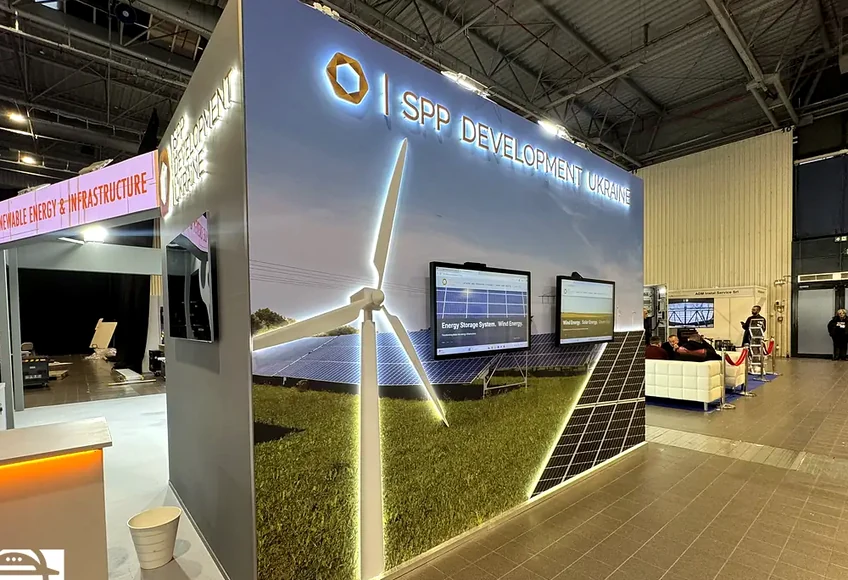
Backlit trade show display and LED lightboxes
A backlit trade show display turns the graphic surface itself into a source of light. Large brand photography and simple messages can remain visually strong even in a busy exhibition hall.
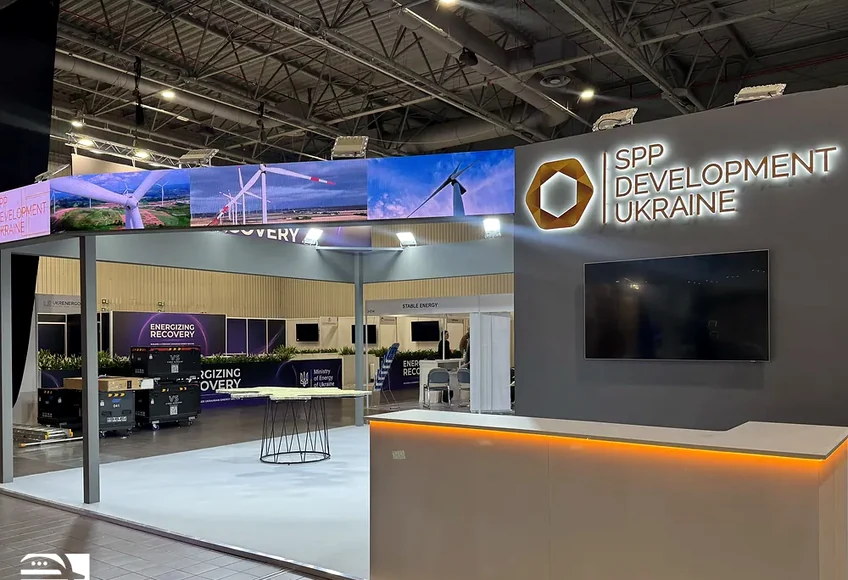
Modern lightboxes can also become part of the booth architecture. A large LED backlit trade show display might form a wall, reception feature or structural element instead of behaving like an accessory placed inside the stand.
But luminous does not automatically mean important. Give the backlit surface a clear editorial job.
Ambient and perimeter lighting
Ambient and perimeter lighting are less about one focal object and more about making the overall space readable.
Indirect light, integrated strips and LED booth lighting can define architectural edges, soften dark areas and distinguish zones. This approach to lighting for trade show booths is particularly useful when visible fixtures would interfere with a clean design.
Integrated structural lighting
Lighting can also be designed into the stand itself.
LED lines may follow structural edges, illuminate shelving, sit inside counters or become part of an overhead feature. In this form, trade show lighting does more than illuminate the architecture: it helps explain it.
Some of the most innovative booth lighting solutions are actually quite restrained. Their strength comes from integration, not from the number of fixtures.
How to Use Lighting to Direct Visitor Attention
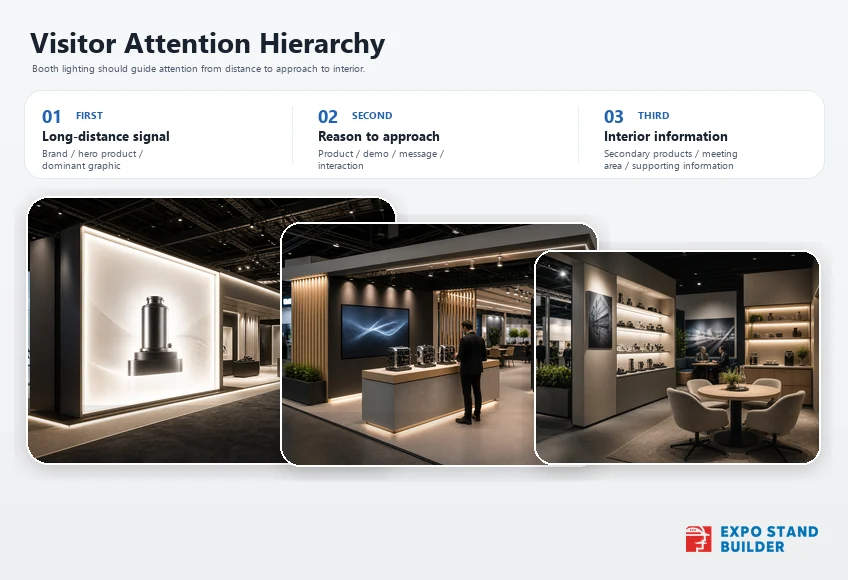
This is where lighting becomes a design system rather than a collection of lamps. Before specifying trade show booth display lighting, decide what a visitor should see first, second and third. The same hierarchy is part of what makes a good trade show booth: the stand should help visitors understand where to look and what to do next.
Create visual hierarchy: what visitors see first, second, third
- First: establish the long-distance signal—a brand, hero product or dominant graphic.
- Second: reveal the reason to approach—a product demonstration, message or interaction.
- Third: make the interior understandable—secondary products, meeting spaces and supporting information.
If everything is equally bright, everything competes. Effective trade show lighting creates priorities rather than uniform illumination.
Highlight products, not walls
Architecture can deserve accent lighting, but it should not automatically receive priority.
If the business objective is to demonstrate machinery, furniture, materials, cosmetics or another physical product, trade show exhibit lighting should help visitors see its shape, texture, colour and important details.
A glowing wall behind a poorly illuminated product has the hierarchy backwards.
Lighting zones: demo area vs. meeting area vs. entrance
A booth does not need to behave as one uniformly illuminated room.
The entrance should be immediately legible. A demo area may require strong controlled light on a product or working surface. A meeting zone often benefits from softer illumination that feels comfortable for face-to-face conversation.
These differences can be created through direction, intensity and fixture placement without turning every zone into a different colour environment.
Backlit Trade Show Displays: When and Why They Work
Backlighting is effective because illuminated graphics can hold their visual presence in a hall full of competing displays. But that advantage disappears when every surface tries to become a focal point. A backlit trade show display works best when the graphic genuinely deserves to anchor the composition.
Fabric backlit vs. rigid backlit panels
Fabric systems are well suited to large-format graphics and reusable lightbox structures. The graphic can be replaced while the underlying system remains in use.
Rigid illuminated panels can make more sense when lighting is deeply integrated into furniture, product presentation or custom architecture.
So the choice is not simply fabric versus rigid. Think about transport, graphic replacement, reuse, construction and the role the surface plays in the booth.
Portable backlit trade show display — options for smaller booths
A portable backlit trade show display can give a small inline booth a strong visual backdrop without requiring an elaborate custom structure.
This is particularly useful when a company attends several events with similar messaging. Portability, replaceable graphics and repeat use may create more value than architectural complexity.
For that situation, a compact backlit display for a trade show can do one clear job very efficiently.
When backlit makes sense and when it’s overkill
Use backlighting when a graphic needs long-distance visibility, when a clean luminous brand wall supports the design or when one illuminated surface can replace several competing accents.
Be more cautious when the stand already contains bright screens, illuminated logos, product lighting and other luminous elements.
The design question is simple: does another glowing surface clarify the hierarchy or confuse it? That is the difference between using light as a tool and using it as decoration.
Practical Lighting Tips Before You Order
A rendering does not have to pay an electrical invoice, comply with a rigging manual or survive installation day. Real tradeshow booth lighting does. That is why the technical questions need to be resolved while the booth is still being designed.
Venue power and rigging restrictions
Never assume that electrical and rigging rules will be identical from one exhibition to another. Check the Exhibitor Services Manual or equivalent show documentation before the lighting system is frozen. Depending on the event and venue, electrical connections, rigging and other services may have to be ordered through designated providers. This is part of the same operational discipline covered in our trade show management playbook.
This is especially important when trade show booth lights are suspended, integrated into overhead structures or require substantial electrical distribution. Discovering a restriction during installation is considerably more expensive than discovering it during design.
Color temperature: warm vs. cool and when to use each
Color temperature affects the apparent character of white light, but there is no universal Kelvin number for a successful booth.
Warmer light can work well with timber, hospitality spaces and environments intended to feel relaxed. Neutral or cooler light may suit technology, clean surfaces or certain product presentations.
More importantly, check how the actual materials look. If visitors need to judge the colour of textiles, packaging, finishes or products, colour rendering matters alongside colour temperature. The right specification is the one that makes the thing you are selling look right.
LED vs. traditional fixtures: cost, heat, lifespan
LED trade show lighting is now a practical default for many exhibition applications because LED technology combines efficiency, compact dimensions, controllability and long service life.
The U.S. Department of Energy notes that good-quality white LED products can have a useful life of roughly 30,000–50,000 hours or more, compared with about 1,000 hours for a typical incandescent lamp.
For an exhibition stand, efficient LED trade show lighting can also mean lower electrical load and less unwanted heat. But LED is not enough of a specification. Output, beam angle, optics, dimming and colour rendering still determine whether a fixture performs well.
Trade Show Lighting Mistakes
Most poor trade show booth lighting examples are not caused by choosing the wrong technology. They start with the wrong planning logic.
- Planning lighting after booth design. Power, mounting points and integrated lighting need to be considered before production drawings are final.
- Making everything equally bright. Without contrast, visitors have no visual priority.
- Lighting the architecture instead of the reason people should stop. Products and important messages often deserve priority over decorative surfaces.
- Ignoring venue electrical and rigging requirements. A technically attractive idea is useless if the venue cannot execute it as designed.
- Choosing light without testing what it illuminates. Products, graphics, materials and people can look very different under different fixtures.
The best trade show booth lighting examples usually do not make you think about the number of lamps at all. You simply understand where to look.
FAQ
The fixture itself is only part of the decision. Cost, venue rules, portability and the type of display all affect the final trade show display lighting solution.
These are the practical questions worth resolving before the lighting specification is approved.
What is the best lighting for a trade show booth?
There is no single best fixture. Effective trade show booth lighting usually combines general illumination with selective accent light based on products, graphics, layout and visitor priorities.
For most modern projects LED is a sensible starting point, but beam control, placement and colour quality matter more than the technology label alone.
How much does trade show booth lighting cost?
There is no useful universal price. Cost depends on fixture quantity and type, electrical service, rigging, installation requirements, venue rules and whether equipment is rented, purchased or integrated into the booth.
Treat booth lighting as part of the design and technical budget rather than as a last-minute accessory.
Can I bring my own lights to a trade show?
Sometimes. But owning the fixtures does not necessarily mean you can install, rig or connect them yourself.
Check the event’s Exhibitor Services Manual for electrical, labour, safety and rigging requirements before bringing your own trade show booth lights.
What is a backlit trade show display?
A backlit trade show display places a light source behind a graphic or translucent surface so the graphic itself becomes illuminated.
It can range from a portable backlit trade show display to a large integrated booth wall. The best applications use backlighting to establish a focal point rather than simply adding brightness.